Friday, July 26, 2013

to Knysna

Animal count: sheep, sprinbok, cattle, monkeys, red heartbok, goats, ostriches, 1 dog

The part of the Karoo we had been in was a Boer stronghold during the wars (the Boer War it was called in my history class (or the "boring war" if you were ten years old and didn't have an engaging teacher, especially when you inadvertently found out there were two of them to compare and contrast) - here they are referred to as Anglo-Boer Wars) and there were photos and captions on the walls of coffee counters and gas stations and other buildings we came into contact with as we passed through.

water at a premium, so catching every drop essential
clever directing of a precious resource
town planning - everyone gets water

We had an hour or so stop in Graaff-Reinet, which was right smack dab in the middle of the Boer-Anglo forays, but which is now a lovely old town, with the now familiar green and white dutch-inspired architecture.  With trees, tiled rooves and courtyards, it had a bit of the look of South America for some reason.  I suppose it was the combination of a European culture on a raw, wild land that gets mighty hot sometimes and mighty wet other times.  When we wer there it was mighty fine.

The Dutch East India Company founded this place in the late 18th century, and named it after the governor of the entire cape colony (Cornelis Jacobvan de Graaff) and his wife (nee Cornelia Reynet)  Now let's just pause for a moment and think about that. Not the fact that husband and wife have practically the same first name.  But that a new town in a new country is given a name that combines both male and female surnames.  Most of the time (99.999%) you only see the man's name attached to places, in the New World especially.  Men of old seem to love attaching their names to places, or the names of where they were born.  But never the names of those women who either traipsed along with them to endure the conditions in tight clothing and no occupation, or were left at home, dealing with babies, and bill paying.  Not to get screeching feminist here, but I find this acknowledgement of the part these people played together charming.


I


t's worth more than an hour's wander, if only to enjoy the various crafts made from mohair, for which this area is famous.  But I must admit, what I was more interested in was finding a hot drink and moving lower in altitude and sitting on the sunny side of the truck.

It was another long drive (no longer a great surprise to us) but our energy picked up as the fields grew greener, the trees grew taller, the mountains grew closer, and we started down to the coast. Around one more steep curve and there is a coastline ahead. 

there's green in them that hills!

I'm not sure what this means, but it looks scary!

sea and sand once again!

to the Karoo

Animal count: cattle, horses, sheep, 1 donkey, other cattle with big humps, kudu, springboks, butreboks, dassie, read heartbok, cape mountain zebras, ostrichesa (I know they are birds and not animals but they can't fly and they are big so they rae included in my list), and 2 dogs

All the way along our travels we were told by other travelers, lodg owners and our guide how cold it is in the Karoo. "Just wait until the Karoo" our guide told us. "Trust me, it's cold there!"

This made some of us a little nervous, as many of our early mornings have been decidedly chilly.  Not 0 degrees chilly, but "I can see my breath" and several-layers-of-clothing-piled on chilly.  Drakensberg pumped it up a notch, or down I should say, although the days were summer-hot. 


toilet stop 1


another toilet stop
on the way to the Karoo
erosion obvious here
It was a long way to the Karoo as well. We stopped for the night in a small town to break up the journey, and then started up again before dawn, not even stopping for breakfast (we had a small box the motel put together for us - a hard boiled egg, a cold sausage, yogurt, an orange and a chocolate wafer.  Toilet stops only.
wow! did you see those baboo.....?  oh, never mind
Even then we didn't get there until nightfall. The last part of the journey was a couple of hours on a gravel road., a not bad gravel road for most of it, and a terrible gravel road for the last half hour, which was only 4 kilometers in distance so you can imagine what a terrible gravel road it must be. I come from Canada and there have been a lot of gravel roads in my history.  Some pretty bad.  But this was probably the worst in my experience. Probably a 9.5 on the scale of 1 to 10 on the "gravel road intensity scale".  And it was almost sraight up.

Ok you get the picture - the Karoo lodge was very high in altitude, very rough in approach and very cold in temperature.  The main lodge showed a flicker of yellow light which turned into exclamations of joy when as came in to a room lit with several lanterns, and a bright little fire.  Our own cabins were lovely stone buildings, but unheated and no electricity (a solar operated foyer light and a bedside lantern).  We never did get exactly warm, but we got as warm as it is possible to get there, with another cloudless sky and hikes around the property. 

I had ony heard of the Karoo in literature and until I went to Australia I had always thought it was there (Karoo, kangaroo - not such a big leap for a child).  A favourite author of mine Thomas Hardy, wrote a poem called "the Dead Drummer" that contained this verse:

Young Hodge the Drummer never knew
Fresh from his Wessex home
The meaning of the broad Karoo,
The Bush, the dusty loam,
And why uprose to nightly view
Strange stars amid the gloam

I came across it again years later when reading Rudyard Kipling's "Bridge-Guard in the Karoo":

Sudden the desert changes,
  The raw glare softens and clings,
Till the aching Oudtshoorn ranges
  Stand up like the thrones of Kings –

We hear the Hottentot herders
  As the sheep click past to the fold –
And the click of the restless girders
  As the steel contracts in the cold –

And the solemn firmament marches,
  And the hosts of heaven rise
Framed through the iron arches –
  Banded and barred by the ties."

no shortage of wind for pumping water

Laying a train through this region could very well have been the single largest contribution to building this country.  The Karoo comprises an enormous amount of South Africa, so that it is even divided into sections: the Upper Karoo, which is itself divided into Great and Little Karoos, and the Succulent Karoo, which sounds like an outback recipe. It is semi-desert - where we were there was only 1 lone tree in the scrubby landscape, although the pioneers who had built this lodge originally in 1852 seem to have planted a few fruit trees which were still there, but very old and scaly.  Mr. lodge owner had growm up in the area so it didn't faze him but Mrs. lodge owner had been a hair stylist in another life and so this must be one incredible lifestyle change.  They must be very much in love, because there is no one else for 50 odd kilometres.  The lack of trees becomes somewhat of a crisis for our little group.  as it means wood is like gold, and there is none available for us to have a fire in our cabins.  With two safari groups arriving from wood-rich locales every week you'd think this might have been anticipated.
day about to break

Karoo lodge
breaking dawn
Coal mining and sheep raising took a lot of the indigenous four legges inhabitants out, but people like our lodge owners are slowly restocking them in ecologically responsible portions.  A few herbivores here, a few carnivores there. 
warming ourselves with sunrise
We saw ostriches, springboks, and butreboks all co-mingling quite calmly.  And another type of zebra.

Did you know there was more than one type of zebra?  I sure didn't. To me any  horse-like animal wearing black and white striped pajamas fit the label of zebra and that was it.  But no.  In South Africa there are two twpes of zebra, Burchell's and Cape Mountain.  There are even different ones in other countries, but two is enough for my brain to process right now.  Not being able to compare them in person I must rely on what the guide tells me.  Cape Mountain zebras have a white stomach and no"shadow' stripes.  Also, I read, a reddish brown nose, a prominent dewlap and a gridiron pattern on the rump.  Ok I believeyou.  How could I have been so stupid as to have confused them with Burchell's zebras?  Silly me.
where are you?
in the Karoo?
Yo-del-a-lay-hee-hoo!
Now we are two
in the Karoo
boop-boop-ba-do
 
Can we please go somewhere warm to discuss it?  Like the little bar area?  The one with the fire and the glasses of wine?

Thursday, July 25, 2013

windy ride in zuzuland


to Drakensburg (no dragons)

Animal Count: monkeys, cattle, horses, zebras, nyalas, goats, sheep, baboons, elands, common duikers, 2 dogs and a pig


grassier
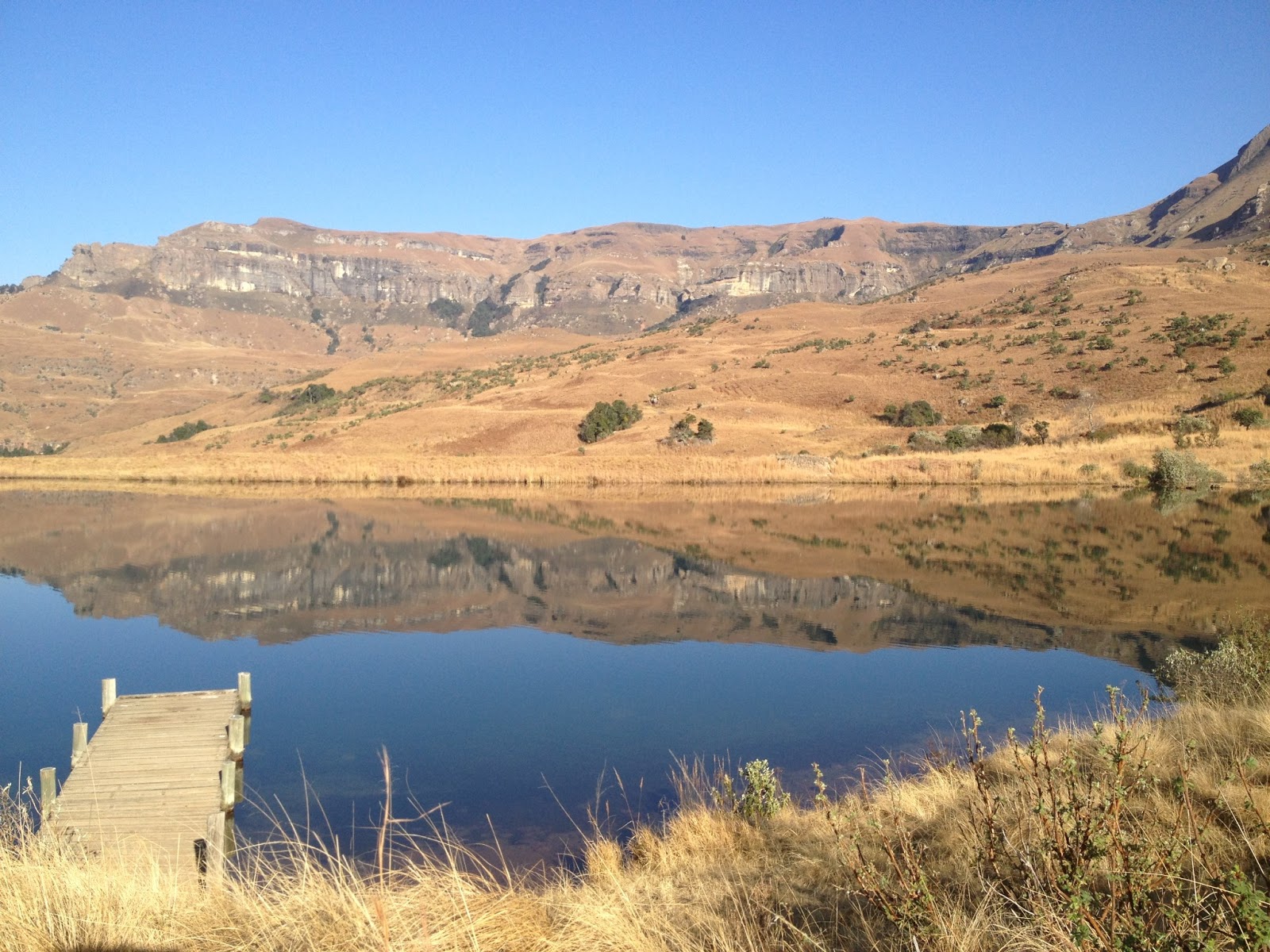
The Drakensberg is every bit as fantasy adventureland as it sounds.  High, dry grasslands, and a steep range of mountains that ring the area making for late morning light and early evening light, but brilliant starshine.  It is the highest mountain range in South Africa, and a good part of it forms the border of Lesotho.
higher
The Zulus call it "Ukhahlamba", which means barrier of spears, while the Dutch Vootrekkers named it Drakensberg (The Dragon Mountains).  We call it awe inspiring, as we follow the track up and up, witnessing some of the chains 200km span.  We change over to a 4x4 for the last bone-breaking 40 minutes or so, in the dark, sloshing through creaks potholes.  The air is biting cold.  We finally make it, peel ourselves from our seats and hobble into the main lodge.  There we see a huge fire blazing in the middle af a large round room, with two big tablesset for dinner, a snug bar off to one side, and big, comfy chairs upon which we flop with ecstatic sighs.

In the morning we see what all those black masses blocking out the stars were.  It was a stunning day, cloudless and warm in the sun.  This is a rare thing in July and you simply can't not go tackling those mountains. 

see our lovely cabin?  see that wall of mountain behind it?
setting off
we could have gone fly-fishing but we chose moutain climbing!
The hike to the vulture nest and back through Stoney Pass is 6 hours, and with winter light, it's best we start soon after breakfast.  The first bit takes us to an enormous rock under which the San people, the area's first peoples, used to camp.  We know this because they left us drawings of their life.  There are dozens of other such artwork dotte about the Drakensberg, but slow erosion of the rocks is hastening their disappearance.  At the time of the San, this boulder would have sheltered many from the rain and the wind and the snow.  They would have camped here and cooked here.  But now, it affords only a bit of shelter from the sun for us, and what in the future for other hikers?

these were drawn with blood....
...but no one really knows what the black came from


Our guide wisely moved us slowly, with several stops to catch breath as we clmbed steeper and steeper. 

The last bit up to the top was about 20 feet of sheer rock.  We had to find small hand holds and foot holds to bring ourselves up, and we all made it, but I haven't done anything like that in a long time!  The vultures that had been circling (not ominously, just because we were getting close to their next) settled down and soared below us to find something a bit smaller and more tasty than us.

At the top we divided, one group to go back at this point, as two wished to go horseback riding later that afternoon.  The rest of us headed along the ridge of the mountain, an undulating trail through high grass and occasional rock inclines.  We stopped for lunch at about the time we could see the others almost straight down and far below, like tiny fruit flys with no wings and hopefully a longer life span. 

this sign was at the start of the hike...
...and this sign was at the end....
The mountains move down a bit more gently on the other side, and we saw horses and a herd of bell-collared sheep moving through the grass.  Twice we saw baboons, big fellows, and they moved into the brush when they saw us.  Our guide told us that they would take on a woman, but not a man.  Thankfully, I have 3 men between me and them!

.....and this was in the middle
my three men preserving me from errant baboons
see those tiny green rooves?  One of them has all our luggage
typical lunch stop - I gaze out a the beauty
and the grandeur of the landscape, Martin sleeps,
Griffiths checks his messages and Wolfgang takes photos
The climb down was not pretty.  Steep, rocky, slippery, narrow, we moved slowly and folcussed only on the step ahead.  This was too bad because it was a fantastic view, given that we were moving down an almost vertical hill, inching along steep zigzags cut into its face.  A group of elands eyed us cautiously, moving when they felt we were too close, but always in a forward direction so they got more and more skittish as we came close.  Finally they either got smart enough or scared enough to move uphill and we passed their alarmed eyes.

nervous Elands
Almost to the minute of 6 hours we returned, voyageurs who had conquered the Drakensberg!!!!  Now for a shower and a nice cold beer!
we were
back home!

High School Confidential

The tour group we have chosen - "Drifters" - is based in South Africa and uses local guides and their own lodges and camps.  They also support the next generation and have chosen a school in Zuzuland not far from their False Bay lodge, so that groups are able to visit and donate to the cause.

We were there in their last week of holidays, but some of the high school graduation class were there to do extra study, and to perform for the tourits.

The school  itself is a series of long low buildings, with classrooms having their own door to the outside.  Many windows are cracked and broken, and walls are peeling paint over cememt blocks.  Razor wire rings the school, and the play grounds are full of broken glass and strewn plastic.


But rooms are a reasonable size, and most children sit at a desk, although some were on benches and shared a table.  A large blackboard held mathematical calculations related to business: the difference between mortgages and loans, what microfinancing was, what to include in a business plan.  The teacher was a large man with a calm face in a timy gentle smile.  I get the feeling he has no other expression.  The students noisily talk over each other, tease, laugh, taunt, joke.  Every once in a while, the teacher uses his hands and voice for calm (it's never completely quiet)

We are to stand at the front and introduce ourselves after which we all receive applause.  I get a significant amount of cheering when I say I am married to Martin and that we work together, but I really got a cheer where I said my birthday is the same as Nelson Mandela's.  I admit that I had a feeling it would get a response, otherwise I would not have mentioned it. For once I was willing to just enjoy a quiet birthday with no big deal attached, but somehow here I felt it was a positive thing.

Other particularly enthusiastic cheers came when our German woman said she was a social worker (does any other population value social workers as much?) and to our young Austrian, who is a little younger than these students and so more or less a "peer".

Then it was our turn to sit and be entertained by their singing.  Suddenly this ragtag clutch of teenagers, some in their uniform and others not, came forth with strong voices in harmony, unaccompainied and untimed.  It was wonderful.  At one point they did a little repetitive dance and two students shyily came forward and enticed their Austrian counterpart to join them,  It was very sweet and nice to have our youngest group member made something of.  Two proud parents and three enthusiastic travel partners clapped along. Then photos, hugs and cheers before we leave them to their students and make a donation for their future.  For further information, contact Drifters:
http://www.drifters.co.za/displayCustomLink.aspx?name=DriftersContact


to Dolphin Coast (no dolphins)

Animal count: hare, wild dog, monkeys

Our return back to urban humanity.  The Indian Ocean roared ouside our window, blue and green with foaming white curls as metres high waves crashed onto the most lovely caramel sand.  It was warm. We had a veranda. They do laundry.  Oh, heaven!


Wearing clothes that hadn't left our backpacks yet, we wandered along the lane a kilometre or so to a clutch of bars and cafes and parked ourselves down with wifi.  Over the course of a few hours we worked, blogged and connected while drinking perhaps the best cocktails I've ever had.  If you are ever in toney, time share, retirement north Durban area of Umhlanga, go to the Sandbar.  Go thirsty.

It was great to see a clean beach, filled with families enjoying a day at the seaside in winter (winter?  this is a nice summer day where I come from!)  We dipped our toes into the third ocean they'd been dipped in (are there only three?  Pacific, Atlantic and Indian? Aren't the rest "just" seas? Aanswers on a postcard please). 

It was the first time I had seen black people on vacation mode.  And for the first time this trip I saw locals of Asian heritage now referred to as Malays or Cape Malays. They weren't originally from Malasia as their name suggests but rather from what is now Indonesia, which had been a Dutch colony from the 17th-19th century.  The Dutch East India Company took from their outpost what they felt was rightfully theirs, namely the inhabitants, and brought them to South Africa as slaves.

They weren't the only ones of course.  Other Southeast Asian regions, political dissidents, and Muslim religious leaders who opposed the Dutch presence were lso sent here, as exiles. This is why there is an Islamic presence here. Although it's not a large presence, most towns of any size seem to have a mosque.

In the second half of the 19th Century, Indians also came to South Africa, as either indentured workers or as 'free' Indians who came to trade and take part in the opportunities afforded by a "new world".  All these "coloured" people were descriminated against in the aparteid era, although not quite as viciously as the native black populations.  In 1994 a democratic constitution was written and immigration policy restrictions were lifted.  People from India, Pakistan, Sri Lanka and Bangladesh came here as new immigrants. However, there remains a major cultural division between these new groups and Indian South Africans,  just as there still is between the white and black populations. 

But here on this lovely day, even though the holiday-makers played on separate beaches, this was not because of a government imposed mandate.  I guess that's some form of progress. We walked along the tide line, sometimes getting more than our feet wet, and shared smiles and words with all.